– Cap Coleman
Ohio has given tattoo lore manys tattoo artist. While there are great artists there now the old timers loom large in the consciousness if our craft.
Al Schifley, Gus Wagner and a man more associated with the Chesapeake Bay, mainly Norfolk and Portsmouth: August “Cap” Coleman.
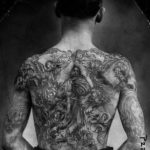
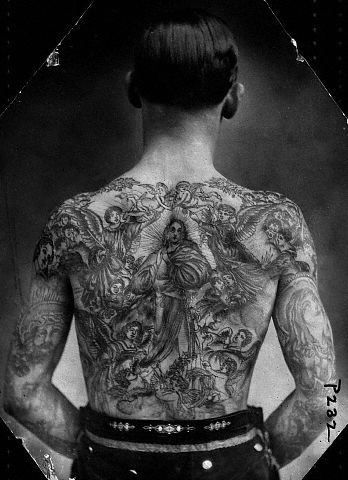
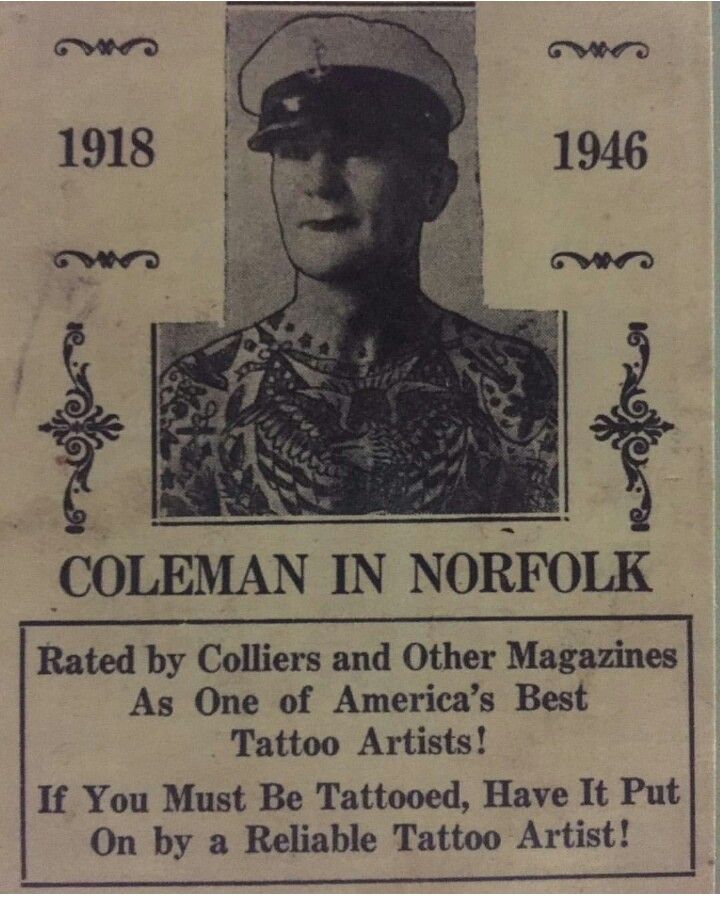
The man was born in 1884. Many rumors surround his birth. He once stated he had learned from his father. Wherever he learned the trade he began as many had as a sideshow attraction and artist. Stoney St. Clair said he was covered “with those big heavy black tattoos.”
From photos that were sold in postcard form at the time we saw a man proud of his ink. With his shorts made of old circuse curtains that is prevalent in photos of the time he heald his head high. Coleman by this time had none or very little of his teeth left. Possibly from growing up poor.
Coleman traveled and learned the trade. At least some of his work looks like some of it was done by hand tattooing in the American style.
By the time World War One started Coleman was plying the needle on soldiers and sailors in Norfolk.
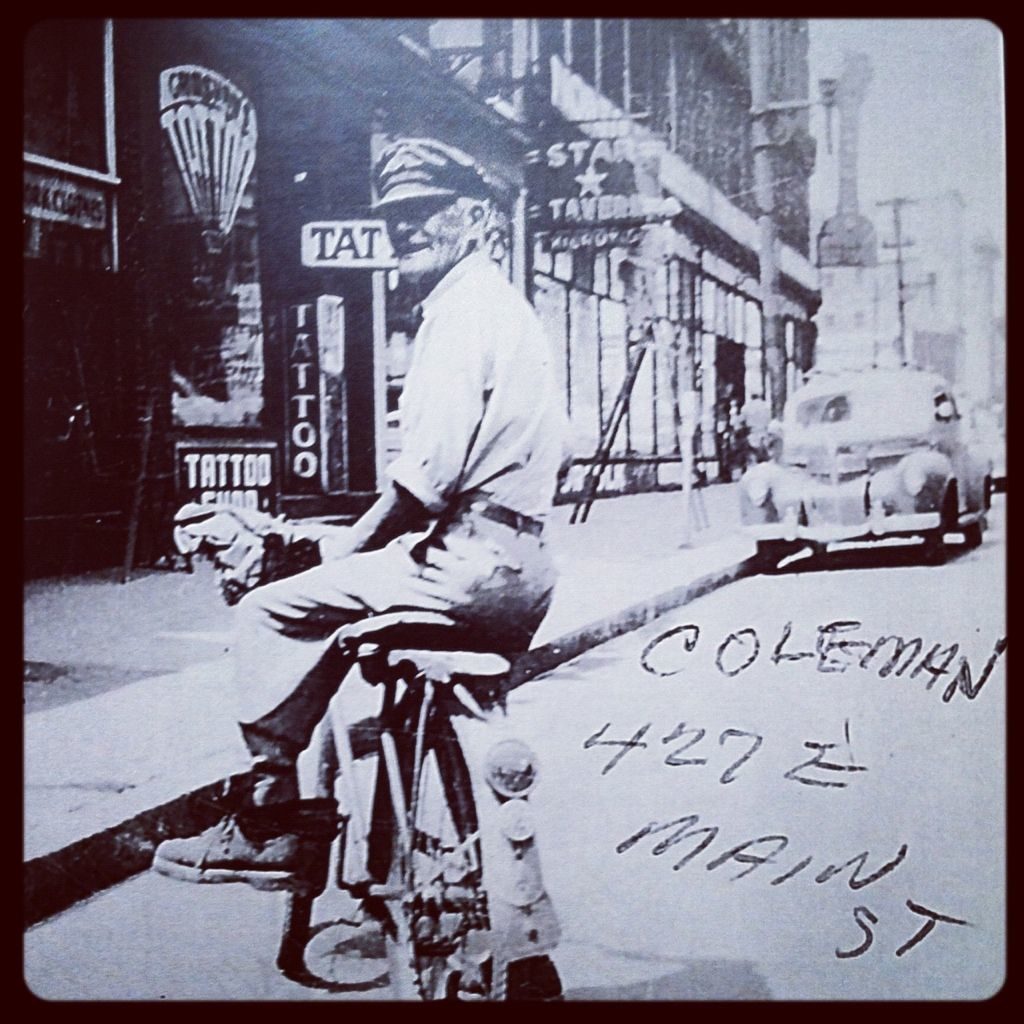
By the 1920s Coleman was one of the best artists on the east coast. His work was of the time; bold outlines, heavy shading. Paul. Rogers related in his memoir written with Doc Don Lucas that Coleman used black and red only.
Perhaps it was that he was of the era where black and red were the only colors. During the second world War he told servicemen that any other color, especially green which was hard to get in the skin at the time, would have and adverse reaction to inoculations and burst the skin.
As for flags he knew well that a few months in the sun would make his Pelikan ink turn blue.
Coleman was a character. He was very assured of his place. He never worried about the competition. He peers was people who are also legends; Lorena Platt, Andrew Steutz, Professor E. J. Miller & William Grimshaw. He didn’t need to put his address on his cards. All it says was Coleman’s Place, Main St., Norfolk, VA.
That stretch was included the Gaitity Theater with its burlesque shows, restaurants and tattoo shops. The Sailor Town was booming.
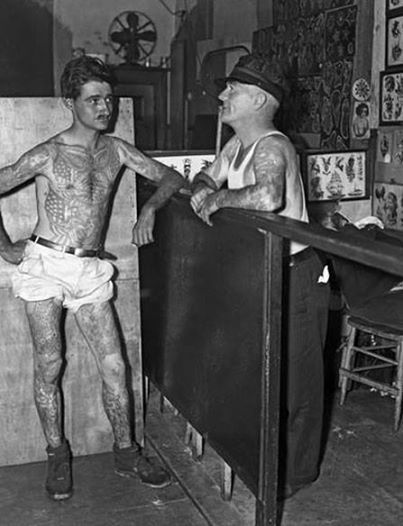
Sailors being sailors have earthy ways of showing respect or disrespect. In the landmark documentary on Sailor Jerry legend in his own right Mike “Rollo” Malone spoke of the navy men relieving themselves on Coleman’s door. Coleman being on one’s fool and with a superior knowledge of electricity installed a metal strip and tied it off with a coil from a model T. When micturation occurred the liquid conducted the voltage giving a drunken sailor a shock of a lifetime.
Coleman was an eccentric man to say the least. He could pinch a penny. His house had no electricity. He and his wife Lena used an out house as there was no running water. He baithed in the river in the back of his home. The neighbors were not amused as one can imagine.
Talk about lowering property values!
Coleman also gave a guy a chance. Leonard L. ‘Stoney’ St. Clair was a sword swallower. He according to his book and the film Stoney Knows How Coleman gave him two machines, colors and some flash from Miller acrossthe street. For those of you who are in the know Stoney became a legend all on his own.
If not buy a book! (I’ll write a review when the 3rd edition is out in June.
Cap also ate cans of food that the labels had peeled off of. From peaches to awful canned spinach it was his fare for lunch. To spite the lunch counters that lined the street.
The story goes that he saw a panther on a guys arm and said he’d done it. The guy said he was full of it. He said it was done by Paul Rogers in Charleston, South Carolina. Coleman was impressed and offered Rogers a job with him afterbthe war via the mail.
Rogers came up there after finishing his stay in Charleston. He had been working on people from the destroyer base but jumped at the chance to work with the man who “used that machine like paintbrush.”
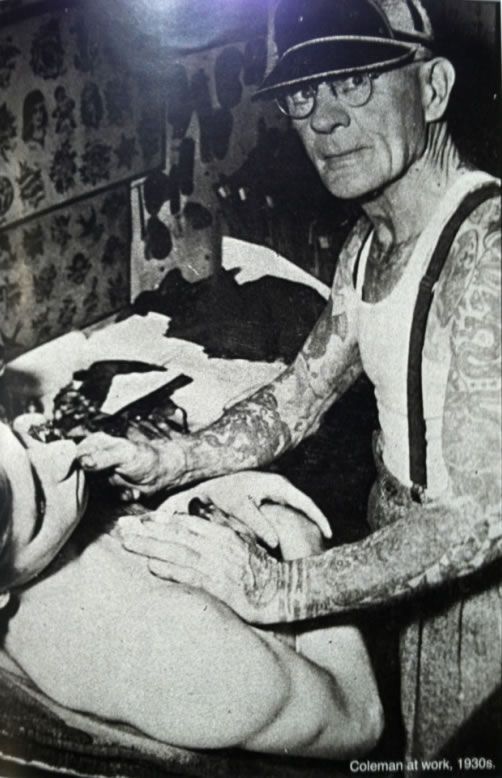
There Rogers worked with Coleman and a host of others. It reads like a list of the old school; Carolina Slim Deal, Sailor Vern as well ge met a man who would tutor Rogers in machine building.Charlie Barrs was “the granddaddy of all good tattooing” according to Rogers. Rogers built the Coleman frame during this time. Rogers said that Coleman was a people hater. And all too many felt that way about him too. My gradmother’s Dutch uncle Ole was tattooed by him! And hated him.Rogers would go on to work with Huck Spaulding, Sailor Eddie & Ester Evens, Ernie Carafa, and took over a shop in Jacksonville, FL. He never really retired. He became THE machine man and many a tattooer spent a hours in the heat and cold in the ‘Iron Factory’ as “Pop” Rogers called it. He was a generous and kind man.Back to Coleman. He worked through the Second World War but Norfolk had other ideas about Main Street. There was a massive ‘renewal’ plan and the buildings, including those with Coleman and Grimshaw’s shops were torn down.
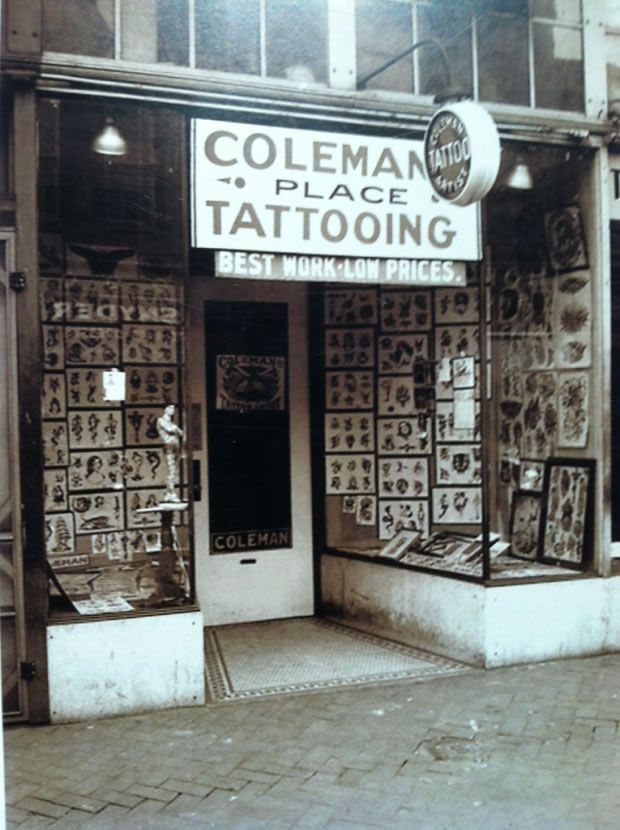
There has been a long existing story that he quit after that. Not true! He and Grimshaw went over the bridge to Portsmouth. There the two worked at Eddie Peace’s place until Grimshaw headed to Pensacola, Florida. It was around then that Coleman bid farewell to the art.
He retired to his home and and was as always tight with a dollar.
Coleman was found dead in the river out back of his house in 1973. He was fishing or baithing. Either way he hit his head and ended up floating in the drink.
Strangely that was the year Sailor Jerry, Al Schifley and Gibbs “Tatts” Thomas, Jerry master, passed away. It was a loss of legends.
I have not found what happened to Lena. But Coleman would be remembered. Not just by sailors, soldiers, ladies of the town and down and out bums. No. Coleman would be remembered for more. And touch the lives of so many.
For all the saving Coleman still lived cheap. He and his wife were childless. As with Stoney who was in a wheelchair, he did have a soft spot for the underdog. Coleman left all of the money he saved to the Virgina School for The Blind and Tidewater Orphans Fund.
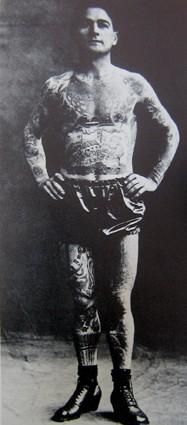
Was Coleman a people hater? Perhaps. But maybe the hard life that anyone in the art was dealing with, going through two world wars and the Great Depression, made him gruff.To me he was complex person working a hard job. And it still ain’t easy these days either!A small collection of his tools of the trade as well as the statue of a man that bears pretty much the same tattoos as Coleman himself is on display in the Mariners Museum in Norfolk.Have a good one, ya hooligans!(Sailor Russ has been tattooing, writing and making art above and below ground for 25 odd years. And he does mean odd. He lives in North East Pennsylvania, with his wife, cats and is heck of a musician.)Note: None of this could have been put down without the scholarly work of Mr. Eldrige at the Tattoo Archive, Doc Don Lucas’s Rogers biography & the work of Carmen Nysen from Buzzworthy Tattoo. (She is related to the down right famous Bert Grimm!)
About The Author